The flight from Guayaquil to the Galapagos wasn’t very long, only about and hour and a half. We landed on Baltra, a small, very flat island that had been used as a military base by Americans during World War II. It was arid, in large part due to its altitude: in the Galapagos, the tallest islands have the most vegetation since humidity levels heighten with elevation. Lowlands are dry, showing little beyond the ashy remnants of lava that created the islands million of years ago.
We boarded a little bus that took us to a ferry. As we descended to the little dock, I noticed a big black bird flying overhead; a Fregatidae, all black except for a bright crimson chest, which expands into a huge feathered balloon during mating season. It’s one of the animals that attracts millions of natures enthusiasts to the Galapagos every year.
A little bird with blue feet watched over us, as we boarded the fairy. The blue footer Booby is the crowd favorite. Nothing like a group of middle aged women yelling “Booby!” with shear excitement, knocking each other over in a scramble to grab their cameras.

The ferry crossed a short channel, that was no more than a quarter of a mile wide, to Santa Cruz Island. There we boarded another little bus with our group and tour guide Katy. As we made our way up to the highlands, the landscape changed rapidly. It transformed from a barren land to one with shrubbery and leafless trees, then leafy trees appeared, and when we got to the highlands, we were engulfed in a misty, green paradise, parches of purple and pink flowers lined the road, and cows gnawed on grass in fenced off little pastures.
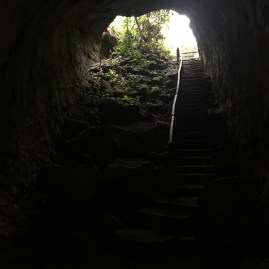
Our first stop was at a lava tunnel. The lava hadn’t flowed through it in millions of years, but the cave it created was still intact –– it was pretty impressive, considering that it had been there for millions of years before anyone had ever passed through it, and it would likely be around for millions more.
Even more impressive were the giant tortoises. We caught site of the first one after returning to the tiny bus, then they started to appear all around us. They were like big rocks, oddly misplaced in the field, speckling the landscape. Most of them were at least two feet in diameter.
Our next destination was a farm that shared a border with the National Park, there the tortoise spectacle took a whole new form.
They dappled the grounds of the park like mushrooms after the rain. We walked around and took pictures. Even though there were turtles anywhere I laid my eye, each one offered something unique. One would be in the mud with its head tucked in. Then there were ones that seemed to be together, hanging out as friends or maybe getting ready for mating season.
Unlike turtles, tortoises aren’t amphibious and spend their lives on land. Their shells are rounder, and their feet are stumpier whereas turtle feet are flat and fin-like. Tortoises often live for over a hundred years, and there are several sub species.

After hanging out with the tortoises we gathered in the main veranda for lunch, our first meal on the island, and were served roasted tuna with potatoes and a yellow garlic sauce common in those parts. The best part was the coffee that was served with dessert. Fresh and authentic; grown, roasted and consumed there on the plantation –– it was the best coffee I’ve ever had.
Full and caffeinated, we set off to our eco-hostel in the quaint seaside town of Santa Cruz.
 Penned by Alina K. A.